

Floor plans and amenity lists dominate most sales conversations. Water storage, generator capacity and the monthly bill shape daily life far more persistently. Before you sign an agreement for sale, society maintenance in Powai deserves the same scrutiny as carpet area, because these building systems decide how a tower absorbs a municipal water cut, a grid outage or a revision of the sinking fund. This guide explains what to verify, which documents to read and how the statutory minimums translate into a monthly figure.
Key takeaways
- Water: Mumbai's municipal supply already trails demand, so on-site storage, standby pumping and rainwater harvesting determine how well a tower withstands a supply cut.
- Power backup: The phrase can describe lifts and stairwell lighting alone or a defined load inside every flat. Confirm scope, capacity and billing in writing.
- Before handover: RERA makes the promoter responsible for essential services at a reasonable charge, and the agreement should keep maintenance money in separate, certified accounts.
- After handover: Maharashtra's model bye-laws set minimum yearly contributions to the repairs fund and the sinking fund, which makes those items a predictable component of every bill.
- Documents: Read the MahaRERA registration and the draft agreement for sale alongside the brochure.
Why does water supply in Powai high-rises need checking?
Water supply in Powai high-rises depends on two variables: the volume the Brihanmumbai Municipal Corporation (BMC) delivers to the plot, and the building's own capacity to store, lift and supplement that volume. Because Mumbai's municipal supply already trails demand, a tower's on-site infrastructure largely determines how sharply a citywide cut reaches each individual flat.
The citywide figures explain the concern. Mumbai consumes about 4,000 million litres a day (MLD) yet runs a daily deficit of almost 565 MLD, according to BMC data reported by Down To Earth (2026). The same report puts non-revenue water, meaning treated water lost to leakage and unauthorised connections before anyone is billed for it, above 30 per cent.
With reservoir stocks near 10 per cent of capacity, the city was operating under a 10 per cent citywide supply cut, and a 20 per cent cut for industrial, commercial and sports club establishments (Down To Earth, 2026). For a residential tower, reduced inflow at the municipal main translates directly into a lower level in the underground tank. The managing committee must then ration pumping hours or purchase tanker water, a cost that is normally recovered from the common maintenance account.
How water moves through a high-rise tower
Most Mumbai towers share the same basic distribution chain, and every link in that chain deserves a specific question:
- Underground sump: the reinforced storage tank that receives the municipal connection. The sump's volume relative to the number of flats determines how many hours of consumption the building can buffer during a cut.
- Transfer pumps and overhead tanks: duty pumps lift water to terrace or intermediate tanks, from which gravity distributes it to the flats below. A standby pump keeps supply running when the duty pump fails or is under repair.
- Hydropneumatic system: a pressurised vessel paired with booster pumps that maintains steady pressure. The system matters most on the upper floors, where the gravity head (the height of stored water above the tap) is small.
- Rainwater harvesting: Mumbai has required rainwater harvesting for buildings above 300 sq m since 2007 (Down To Earth, 2026). Ask whether the installed system recharges groundwater or feeds usable storage.
- Recycled water: a sewage treatment plant (STP) can supply treated water for flushing and landscaping through a separate, dual plumbing line, which reduces the building's draw on municipal water.
Questions to ask about water
- What is the combined capacity of the underground and overhead tanks, and how many days of normal consumption does that capacity represent?
- Is there a standby pump for each duty pump, and are the pumps connected to the backup power circuit?
- Do the upper floors receive a hydropneumatic or booster arrangement?
- Will treated STP water serve flushing cisterns through separate pipes?
- During a cut, who authorises tanker purchases, and how is that expense apportioned among flats?
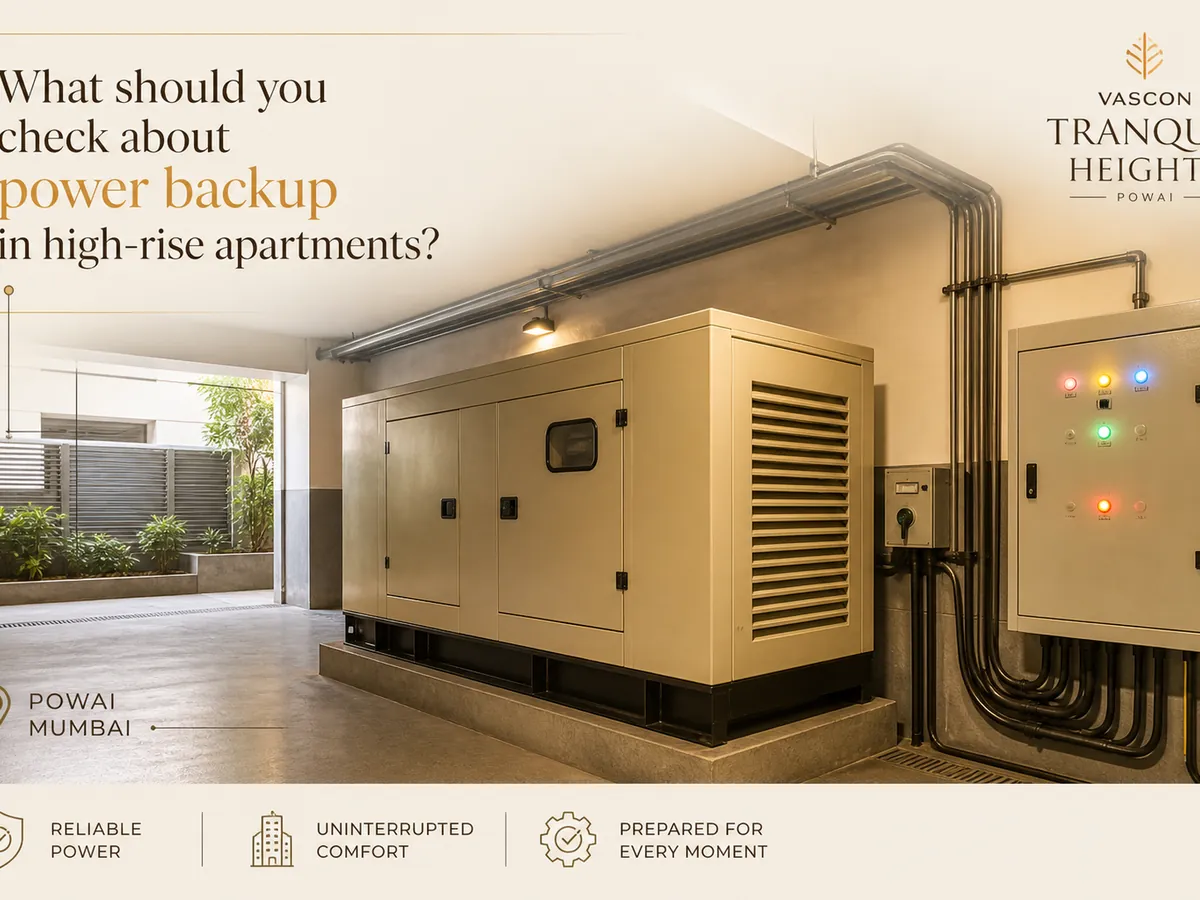
What should you check about power backup in high-rise apartments?
Power backup in high-rise apartments usually means a diesel generator (DG) set that starts automatically when the grid fails. The decisive question is scope: which loads the generator carries, how much capacity each flat receives, how quickly the changeover happens and how residents are billed for fuel and upkeep.
A tower cannot function safely without lifts, water pumps and fire safety systems, so those common loads make the first claim on any generator's capacity. A brochure line reading "power backup" can therefore describe those essentials alone or a fixed allowance for lights and fans in every flat. That distinction determines whether an evening outage means a dark apartment or an ordinary evening at home.
Three common levels of backup
- Common areas only: lifts, water pumps, stairwell and corridor lighting, fire-fighting pumps and security systems; individual flats lose power during an outage.
- Common areas plus a fixed flat allowance: a defined load per flat, usually enough for selected lights and fans, enforced by a load limiter on the flat's DG circuit.
- Full or near-full flat backup: less common and considerably more expensive to operate, because generator fuel and servicing costs are passed on to residents.
Technical points worth confirming
- Generator rating: capacity is quoted in kilovolt-amperes (kVA), the apparent power the set can deliver. Ask for the rating and the load calculation behind it.
- Changeover: an automatic mains failure (AMF) panel starts the generator and switches the load without manual intervention, which matters at night and during monsoon outages.
- Lift safety: an automatic rescue device (ARD) moves a stalled lift car to the nearest landing and opens the doors when grid power fails.
- Metering and billing: a separate DG meter per flat allows billing on actual consumption rather than an equal share of the fuel bill.
- Upkeep: confirm who holds the annual maintenance contract for the generator before and after handover.
How do RERA maintenance charges before handover work?
Section 11(4)(d) of the Real Estate (Regulation and Development) Act, 2016 makes the promoter responsible for providing and maintaining essential services, on reasonable charges, until the association of allottees takes over maintenance (iPleaders, 2019). Buyers should therefore check that RERA maintenance charges before handover are collected, held and accounted for separately.
The same iPleaders analysis describes up-front maintenance collection as an acceptable practice when certain conditions are satisfied. The money should not be treated as developer income, should sit in separate bank accounts for the maintenance corpus and the maintenance charges, and should be supported by accounts certified by a chartered accountant. The balances and a certified income and expenditure statement should then pass to the residents' association at handover.
A maintenance corpus is a one-time deposit collected around possession and transferred to the society as a long-term reserve, distinct from the recurring monthly charge. Because buyers often pay both, the draft agreement for sale should state each amount, the period it covers and the basis of calculation.
When reading the agreement, look for these specific provisions:
- The number of months of advance maintenance demanded at possession, and the rate basis (per square foot of carpet area or a fixed sum per flat).
- A clause committing the developer to keep maintenance money in separate, certified accounts.
- The procedure and timeline for transferring the corpus and any unspent balance to the society.
- Who pays the outgoings attributable to unsold flats during the interim period.
How is society maintenance in Powai charged after handover?
Once the cooperative housing society is registered and takes over, the managing committee raises a periodic bill under the society's bye-laws. The bill bundles service charges, municipal property tax, water charges, insurance and statutory fund contributions, and the repairs and sinking fund components are tied to each flat's architect-certified construction cost.
Under the Maharashtra model bye-laws, the general body fixes the repairs and maintenance fund rate, subject to a minimum of 0.75 per cent a year of each flat's construction cost as certified by the architect (Maharashtra Cooperation Commissioner, 2014). That fund meets the expense of normal recurring repairs to the society's buildings and property.
Under the rules for a sinking fund Maharashtra housing society members pay into, the minimum is 0.25 per cent a year of each flat's certified construction cost, excluding the proportionate cost of land (Maharashtra Cooperation Commissioner, 2014). The general body may later resolve to use the sinking fund for reconstruction of the society's buildings. Revised model bye-laws were still awaited in late 2026 to clarify day-to-day implementation (Free Press Journal, 2026).
A worked illustration
For illustration only (this is not a Tranquil Heights figure), take a flat whose certified construction cost is ₹50 lakh. At the bye-law minimums cited above, the repairs fund contribution would be ₹37,500 a year, or about ₹3,125 a month. The sinking fund contribution would be ₹12,500 a year, or about ₹1,042 a month.
Those two lines are floors, not ceilings, because the general body can resolve to collect more. Service charges, property tax, water charges and insurance then sit on top of the fund contributions, so the statutory minimums explain only part of the eventual bill.

What else appears on the society maintenance bill in Mumbai?
When it comes to society maintenance charges Mumbai buyers compare, headline per-square-foot rates reveal less than the components of one specific building's bill. Service charges cover staff, housekeeping, security, lift and pump contracts and common electricity, and those costs rise with the amount of shared equipment a tower runs.
Maharashtra has notified amended co-operative housing society rules that set clearer methods for calculating maintenance components, including water charges based on the number of water taps in a flat (Free Press Journal, 2026). The same rules also tighten the penalty for paying late.
Maharashtra's amended housing society rules cut the maximum penal interest on delayed maintenance dues from 21 per cent to 12 per cent a year (Free Press Journal, 2026).
Share on LinkedIn · Share on X
Non-occupancy charges Maharashtra societies apply to rented-out flats are now capped. The limit is 10 per cent of service charges, the same Free Press Journal report (2026) notes. Investors planning to let a Powai flat should therefore budget for that surcharge on the service charge component, not on the whole bill.
How do amenities and tower design affect the monthly bill?
Every shared asset a tower operates, from lifts and pumps to landscaped decks and clubhouse equipment, adds staffing, electricity and servicing costs to the common account. Amenity-rich projects therefore tend to carry higher service charges, so buyers should weigh amenity lists against the operating budget needed to keep them running.
Tranquil Heights by Vascon Engineers Limited is planned as a three-wing residential community in Powai with podium-level lifestyle amenities, rooftop social and wellness spaces and an observatory deck. Ask our team about the services planned for the building alongside the amenities, including water storage, backup power scope and the expected maintenance structure.
The project's MahaRERA registration number is PR1180002600330. The project website notes that plans, specifications and amenities are indicative and subject to approvals, so the registered details on the MahaRERA website remain the reference point before any booking decision.
Powai high-rise buying checklist: what to check before you sign
A Powai high-rise buying checklist works best when you follow it in order, moving from public records to the agreement and finally to the people who will run the building:
- Verify the registration: look up the project on the MahaRERA website and compare the registered details with the brochure.
- Map the water system: ask for tank capacities, pump redundancy, the booster arrangement for upper floors, rainwater harvesting and STP reuse.
- Define power backup in writing: confirm which loads the generator carries, the per-flat allowance if any, AMF changeover, ARD in lifts and the metering method.
- Read the maintenance clauses: note the advance maintenance period, the corpus amount, the rate basis and the commitment to separate, certified accounts.
- Estimate the fund contributions: apply the bye-law minimums to your flat's likely certified construction cost to see the floor for repairs and sinking fund lines.
- Ask about rental scenarios: if you may let the flat, factor in non-occupancy charges on the service charge component.
- Plan for handover: ask how and when the corpus, balances and certified accounts will pass to the society.
What this means for you
Maintenance bills continue for as long as you own the home, even after the home loan is repaid, so they belong in your budget from the first site visit. Treat society maintenance in Powai as a running cost that reflects the building's water, power and amenity infrastructure, rather than as an afterthought to the purchase price.
For end users, the practical test is resilience: whether the tower keeps water flowing and lifts moving during cuts and outages. For investors, the test is predictability: whether fund contributions, service charges and any non-occupancy surcharge leave rental yields intact.
To discuss configurations and the building services planned at Tranquil Heights, visit the Sales Experience Centre at Unit No. 507, Light Hall A Wing, 5th Floor, Light Hall Building, Saki Vihar Complex, Muranjan Wadi, Chandivali, Powai, Mumbai 400072, or call +91 7026216868.
Frequently asked questions
Can a developer collect maintenance before handover in Maharashtra?
Yes. Section 11(4)(d) of RERA allows the promoter to provide essential services on reasonable charges until the association of allottees takes over. The agreement should keep that money in separate, certified accounts and provide for transfer of the balance to the society.
How is the sinking fund calculated in a Maharashtra housing society?
The model bye-laws set a minimum of 0.25 per cent a year of each flat's architect-certified construction cost, excluding land cost. The general body can fix a higher rate, and the fund can be used for reconstruction on a general body resolution.
Can a society charge more for a rented-out flat?
Yes, through non-occupancy charges. Under the amended co-operative housing society rules, those charges are capped at 10 per cent of service charges rather than the whole bill.
Does power backup in a high-rise cover the whole flat?
Not always. Many towers back up only lifts, pumps and common lighting, while others add a fixed load per flat, so confirm the scope, capacity and billing method in writing before signing.